fabricante profesional, desde 2009.
difundiendo el aroma del amor por todo el mundo.


español
Categorías
Nuevo Blog
Cómo elegir el difusor de aroma adecuado para su espacio comercial: una guía de compra completa August 27 , 2026
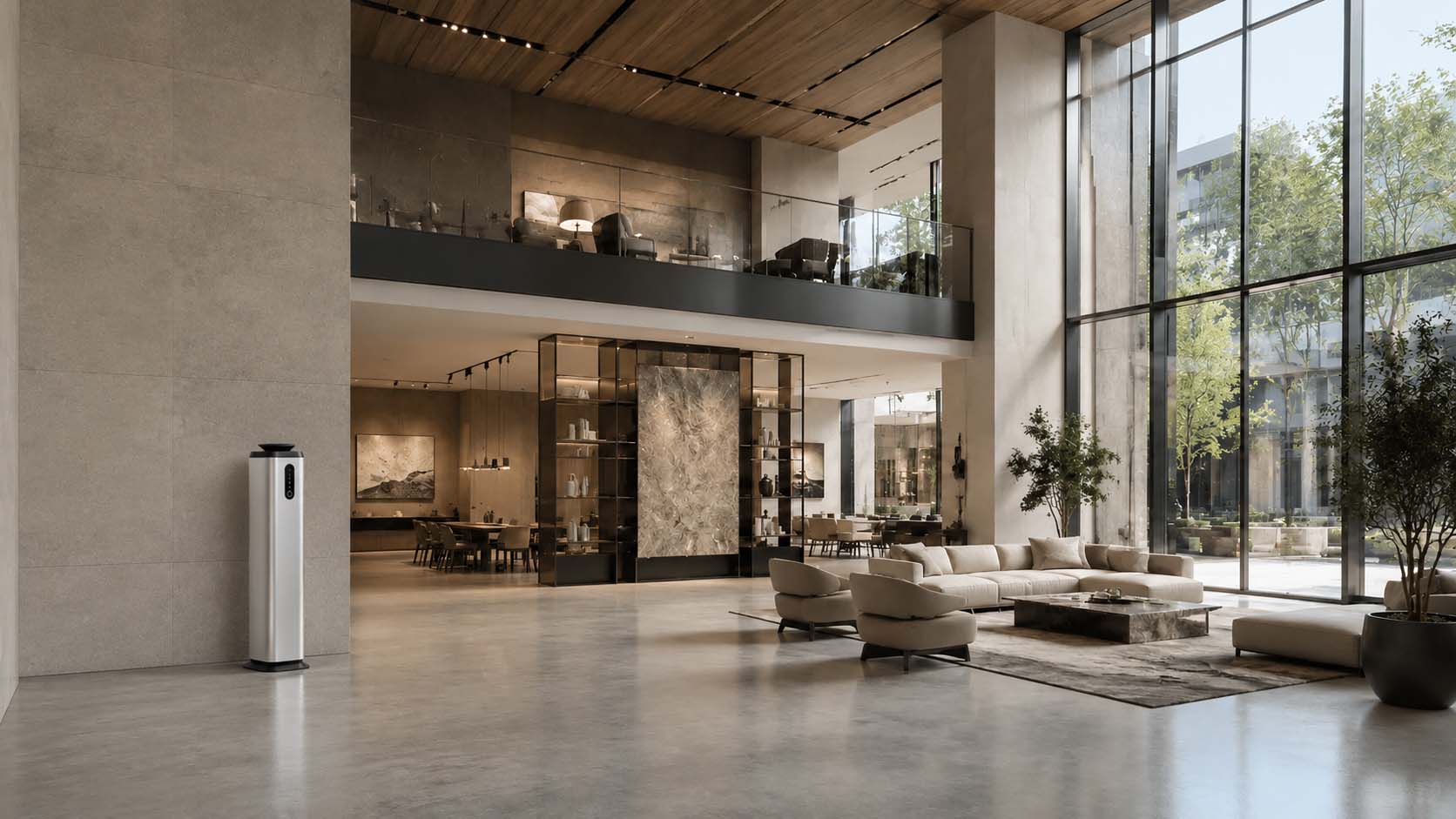
Elegir un difusor de aromas comercial no es simplemente una cuestión de encontrar el modelo con mayor cobertura mediática publicada.
El vestíbulo de un hotel, una boutique de moda, la recepción de una oficina, un gimnasio, una sala de exposiciones y un centro comercial pueden tener superficies similares, pero alturas de techo, patrones de flujo de aire, horarios de funcionamiento, límites de ruido y normas de instalación completamente diferentes.
La máquina de aromatización adecuada debe encajar tanto con el edificio como con la estrategia de fragancias.
Esta guía ofrece a los operadores hoteleros, minoristas, administradores de propiedades, distribuidores y equipos de compras un proceso práctico para seleccionar un difusor de aromas comercial sin sobredimensionar el equipo ni pasar por alto los costos operativos.
Seleccione un difusor de aromas comercial solo después de confirmar seis datos:
El área o zona exacta que debe perfumarse
El volumen cúbico de esa zona
Cómo entra, se mueve y sale el aire del espacio.
Si la instalación debe ser independiente, montada en la pared o conectada al sistema de climatización.
El programa de funcionamiento requerido, el nivel de ruido y el método de control.
El consumo previsto de aceite aromático, la carga de trabajo de mantenimiento y el coste total.
La información publicada es útil para elaborar una lista de candidatos preseleccionados. No sustituye a una inspección in situ ni a una puesta en marcha en el lugar.
Empiece por el propósito del proyecto, en lugar de por la máquina.
Los diferentes objetivos pueden requerir diferentes planes de aromatización:
Un hotel puede querer transmitir una impresión de llegada uniforme en el vestíbulo principal.
Un minorista puede desear crear un ambiente de marca reconocible cerca de la entrada y la zona de ventas.
Es posible que una oficina desee una experiencia de recepción discreta sin que ello afecte a las áreas de trabajo individuales.
Una sala de exposición inmobiliaria puede necesitar fragancia durante las presentaciones, pero no durante la noche.
Un spa puede requerir un funcionamiento silencioso y una menor intensidad de luz cerca de las salas de tratamiento.
Un operador con múltiples ubicaciones puede priorizar la estandarización de los entornos y la sencillez de los procedimientos del personal.
Escribe una frase que defina el resultado deseado. Por ejemplo:
Cree una fragancia sutil y uniforme en los 600 m³ de recepción y sala de espera durante el horario de apertura, sin que el aroma penetre en las salas de reuniones adyacentes.
Esto es más útil que pedir "una potente máquina de fragancias".
La selección de difusores comerciales debe comenzar con el volumen de la habitación:
Volumen del espacio = largo × ancho × altura media del techo
Por ejemplo, una tienda que mide 20 metros por 10 metros con un techo de 4,5 metros tiene un volumen abierto aproximado de:
20 × 10 × 4,5 = 900 m³
Dos locales con la misma superficie de 200 m² pueden requerir equipamiento diferente si uno tiene un techo de 3 metros y el otro un atrio de 7 metros.
Registre más que la cifra principal. Incluya:
Áreas abiertas y cerradas
Entrepisos y atrios
Escaleras que conectan otros pisos
Probadores o habitaciones privadas
Puertas exteriores que se abren con frecuencia
Áreas separadas por muros de altura completa
Espacios que deben permanecer sin perfume
No sume automáticamente todas las habitaciones en un solo total. Una oficina cerrada y un vestíbulo abierto pueden requerir un control independiente, incluso si forman parte de la misma propiedad.
El aroma sigue el movimiento del aire. Un plano por sí solo no puede mostrar cómo se propagará.
Durante el estudio del sitio, identifique:
Rejillas de suministro y retorno de HVAC
Horarios de entrada de aire fresco
Ventiladores de extracción
Puertas giratorias, correderas o de apertura permanente
Escaleras mecánicas, vestíbulos de ascensores y huecos de escaleras
Entradas de mucho tránsito
Ventiladores grandes o cortinas de aire
Tabiques y estanterías altas
Límites del servicio de alimentos o de la cocina
Puestos de trabajo y asientos de larga duración
Lo últimoNorma ANSI/ASHRAE 62.1-2025Abarca la ventilación, la filtración, los controles, el funcionamiento del edificio y el mantenimiento para lograr una calidad del aire interior aceptable. Su edición de 2025 incluye requisitos actualizados para la ventilación controlada por demanda, lo cual es relevante dado que el flujo de aire puede variar según la ocupación y la programación del sistema.
Un difusor de aromas debe funcionar con el flujo de aire del edificio, pero no proporciona aire fresco, no elimina contaminantes ni reemplaza la ventilación.Guía actual de la EPA de EE. UU. sobre la calidad del aire en interiores.Identifica el control de la fuente de contaminación, la ventilación y la filtración o purificación del aire como estrategias fundamentales para la calidad del aire interior.
Si un espacio presenta problemas de humo, humedad, moho, drenaje, residuos de alimentos o ventilación, investigue primero la causa. No utilice fragancias para ocultar un problema estructural sin resolver.
Los formatos principales son los sistemas autónomos, los sistemas de montaje en pared y los sistemas conectados al sistema de climatización (HVAC).
Las máquinas independientes se colocan en el suelo, en una estantería o sobre la superficie de un mueble estable. Suelen ser el formato más rápido de instalar y reubicar.
Son útiles cuando:
La ubicación necesita una prueba piloto
El acceso a los conductos no está disponible.
La zona objetivo requiere control independiente.
El inquilino no puede modificar el edificio.
La distribución de la planta cambia con regularidad.
El equipo se puede colocar de forma segura.
Las limitaciones son la visibilidad, el ruido local, la gestión del cableado eléctrico y la posibilidad de que la fragancia se concentre cerca de la unidad.
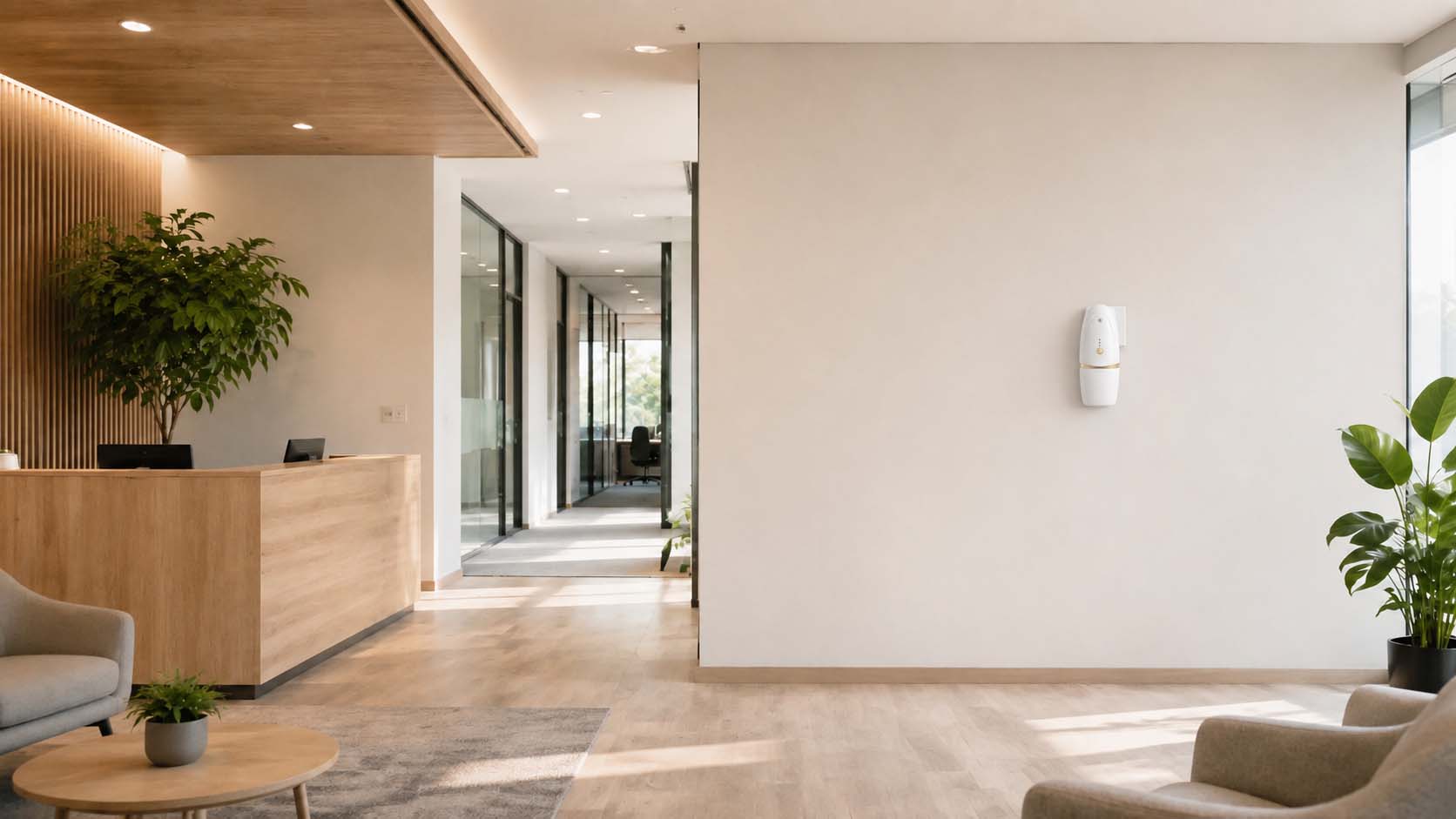
Los equipos montados en la pared permiten mantener despejados mostradores y suelos. Son adecuados para oficinas, pasillos, baños, pequeñas zonas comerciales y áreas de recepción, siempre que se disponga de una pared y una toma de corriente apropiadas.
Compruebe que el dispositivo no quede bloqueado por muebles, cortinas, mercancía, puertas o filas de clientes. Asimismo, debe permanecer accesible para el cambio de aceite y el mantenimiento.
An HVAC scent diffuser introduces fragrance into compatible building airflow for broader distribution.
This can suit large permanent spaces when:
The intended area matches a controllable HVAC zone
Equipment should remain outside the customer area
The duct route and injection position are suitable
Facility staff can provide service access
The building owner and engineering team approve the installation
Do not connect tubing to an arbitrary supply or return duct. A qualified building or HVAC professional should review airflow direction, pressure, shared zones, filtration, operating hours, and the risk of fragrance reaching unintended areas.
Coverage should be only one line in the comparison.
Commercial equipment should allow the operator to reduce or increase output through controlled work and pause periods. The available range should be suitable for the smallest intended setting, not only maximum output.
Check whether the machine supports daily time periods, different days of the week, automatic restart, and an easy method for returning to approved settings.
Noise matters in spas, meeting areas, quiet retail environments, VIP lounges, and reception desks. Ask how the published noise figure was measured and assess the sample in the actual placement position.
A larger bottle can reduce refill frequency, but it also increases the amount of oil stored in the device. Select capacity using operating hours, tested consumption, access frequency, and staff responsibility.
Possible options include buttons, touch controls, Bluetooth, Wi-Fi, or an App. More connectivity is useful only if the customer can support account management, permissions, updates, network access, and staff training.
Public-facing equipment may need a lock, hidden controls, secure oil access, or placement outside customer reach.
Confirm how staff reach the oil bottle, atomizer, tubing, seals, filter, and power connection. A concealed installation still needs convenient service access.
The following framework helps narrow the format before comparing individual models.
| Commercial Space | Main Buying Priority | Typical Starting Format |
|---|---|---|
| Large hotel lobby | Broad coverage, quiet operation, premium appearance | Floor-standing or reviewed HVAC solution |
| Fashion or lifestyle retail | Local control, flexible placement, brand presentation | Standalone commercial diffuser |
| Office reception | Subtle output, low noise, simple maintenance | Compact standalone or wall-mounted diffuser |
| Showroom or sales center | Scheduling, visible design, changing occupancy | Floor-standing diffuser |
| Spa or wellness reception | Quiet operation, low minimum output | Compact or wall-mounted diffuser |
| Large multi-zone property | Independent zones and centralized distribution | Multiple standalone units or engineered HVAC plan |
These are starting points, not automatic prescriptions.
TheDANQ M63 floor-standing scent diffuseris designed for large commercial areas. Current company materials publish a 1,000 ml bottle, standalone installation, low-noise operation, and coverage up to 4,000 m³.
That published figure should be used to shortlist the model, not to guarantee performance in every 4,000 m³ property. A high-ceiling lobby with open doors and strong fresh-air supply may perform differently from an enclosed showroom of the same volume.
The Q1000PRO is part of DANQ’s commercial scent equipment range and can be considered for retail, hospitality, office, and other project environments.
Because final selection depends on the current model configuration, request the latest Q1000PRO specification sheet, installation options, oil capacity, control functions, noise conditions, consumption estimate, and model-specific documents before purchase.
The S915 is a wall-mounted plug-in model designed to keep floor and counter space clear. DANQ product materials describe waterless operation, Bluetooth control, and quiet performance.
Confirm the plug standard, mounting orientation, coverage requirement, lowest output, oil capacity, and service access for the destination market and intended location.
Unit price does not show the full cost of a commercial scent program.
Compare:
Equipment price
Installation or electrical work
Fragrance-oil consumption
Oil price and shipping classification
Refill and cleaning labor
Atomizer cores, seals, tubing, and other wear parts
App or remote-management requirements
Staff training
Replacement equipment or downtime allowance
Freight, duties, and local taxes
A basic operating estimate can use:
Monthly oil cost = tested hourly consumption × daily operating hours × operating days × oil price
Do not use maximum-output consumption if the approved program runs at a much lower duty cycle. Test with the selected fragrance because viscosity and volatility can affect atomization and consumption.
Also compare labor. A lower-priced device that needs frequent local attention may cost more across 30 or 100 locations than equipment with a longer, predictable refill cycle.
The machine, oil, and settings operate as one system.
Before approving bulk oil or equipment, verify:
Atomization stability
Fragrance character after diffusion
Residue around the outlet
Compatibility with tubing, seals, and the atomizer
Consumption under the proposed schedule
Performance after extended operation
Required cleaning interval
A fragrance that smells balanced on a blotter may change after diffusion. Highly volatile notes may dominate first, while heavier materials can affect persistence and maintenance.
Request the current Safety Data Sheet and other documents required for the exact oil, application, and destination market. Do not assume that one fragrance document covers every formula or that every oil is compatible with every diffuser.
Start below the expected final setting and increase gradually.
A useful pilot should include:
Installation during normal building operation
An agreed starting work and pause cycle
Checks at the entrance, center, boundaries, and staff positions
Review during quiet and busy periods
Oil-level and maintenance records
Customer and staff feedback
A documented final setting
Use a simple intensity scale such as:
Absent
Subtle
Noticeable
Strong
Uncomfortable
Ask new arrivals as well as employees. Staff may become less aware of the fragrance after extended exposure.
If the scent reaches restaurants, treatment rooms, neighboring tenants, private offices, or other unintended areas, adjust placement, output, zoning, or operating periods before adding more equipment.
Provide enough information for a project-specific recommendation.
Your RFQ should include:
Country and destination market
Type of commercial property
Floor plan and photographs
Length, width, and ceiling height
Target scenting zones
Areas that must remain unscented
HVAC information and operating schedule
Door and traffic conditions
Required installation format
Daily business hours
Noise expectations
Preferred control method
Fragrance direction
Estimated number of locations
Sample requirements
OEM/ODM requirements
Required model-specific documents
Avoid asking only, “Which machine covers 1,000 square meters?” The supplier needs volume, airflow, zoning, and operating information to make a useful recommendation.
Before approving the purchase order, confirm:
Approved model and hardware revision
Installation method and placement drawing
Voltage, adapter, and plug standard
Oil bottle and atomizer configuration
Fragrance code and approved sample
Initial operating schedule
Cleaning and refill procedure
Spare-parts list
Warranty and after-sales process
Packaging and accessories
Logo, color, or App customization
Current model-specific compliance documents
Pre-shipment inspection criteria
Change-control process
Certification claims should always be verified by exact model and destination. A document for another SKU or an earlier hardware version may not apply to the equipment being ordered.
Calculate the cubic volume using length × width × average ceiling height. Then evaluate airflow, doors, HVAC schedules, zoning, and fragrance intensity before choosing the final model.
No. An oversized machine may create an uncomfortable hot spot, short work cycles, higher cost, or unnecessary noise. The lowest controllable output is important in smaller or quiet spaces.
Choose standalone equipment for flexible placement, pilots, and independent local control. Consider HVAC integration for large permanent zones only after the building system and shared airflow have been reviewed.
A fragrance system is not a substitute for source control, cleaning, ventilation, filtration, moisture correction, or building maintenance. Resolve the source of persistent odors first.
The interval depends on the model, oil, schedule, environment, and operating hours. Follow the model-specific instructions and record refills, cleaning, consumption, and component replacement.
Send the property type, dimensions, ceiling height, HVAC information, doors, business hours, installation restrictions, fragrance direction, destination market, and expected quantity.
The best commercial scent diffuser is not automatically the machine with the highest output. It is the system that delivers controllable fragrance across the intended zone while remaining practical to install, operate, refill, clean, and support.
Measure cubic volume, map airflow, compare installation formats, calculate operating cost, and test the selected machine with the selected fragrance in the real property.
DANQ fabrica equipos de difusión de aromas desde 2009 y ofrece soporte para proyectos comerciales, de climatización (HVAC), domésticos, automotrices, de aceites aromáticos y OEM/ODM. Los compradores pueden solicitar recomendaciones de modelos, catálogos de productos, cotizaciones, muestras de equipos y muestras de fragancias.
Contacte con DANQ Aroma para obtener recomendaciones sobre difusores de aromas comerciales.

fabricante profesional, desde 2009.
difundiendo el aroma del amor por todo el mundo.


Guangzhou DANQ Environmental Technology Co.,LTD