fabricante profesional, desde 2009.
difundiendo el aroma del amor por todo el mundo.


español
Categorías
Nuevo Blog
Sistema difusor de aromas HVAC vs. independiente: guía para compradores comerciales August 19 , 2026
Un proyecto comercial de ambientación con fragancias puede influir en cómo los clientes evalúan y recuerdan un espacio, pero el equipo por sí solo no crea ese resultado. Un metaanálisis del Journal of Marketing que abarca 64 artículos, 15.447 encuestados y 671 efectos encontró aumentos promedio de aproximadamente del 3% al 15% en las métricas de respuesta del cliente. El gasto estimado aumentó aproximadamente un 3% en un entorno promedio.
Los resultados variaron según la congruencia de la fragancia, la familiaridad, la concentración y el contexto. Una fragancia mal combinada o demasiado intensa puede tener un rendimiento inferior, por lo que se debe comenzar con el espacio y el objetivo comercial, no con el mayor número de cobertura.
Esta guía explica cuándo elegir un sistema difusor de aroma HVAC, cuándo tiene más sentido un difusor de aroma comercial independiente y qué deben verificar los equipos de compras antes de aprobar una implementación.
“Hacer que el vestíbulo huela bien” no es un planteamiento de proyecto medible. Un hotel, una cadena minorista, un promotor inmobiliario y un operador de oficinas pueden usar fragancias, pero cada uno debe definir un resultado diferente.
Su objetivo podría ser:
Crear una experiencia de llegada reconocible en múltiples propiedades
Mejorar las percepciones de comodidad o coherencia de marca
Animar a los clientes a explorar un espacio comercial
Crear una atmósfera premium en un centro de arrendamiento o apartamento modelo
Estandarizar la intensidad de la fragancia entre ubicaciones y horarios de operación
Establezca una referencia inicial antes de la instalación. Realice un seguimiento del tiempo de permanencia, la conversión, el valor promedio de transacción, los comentarios de los huéspedes, las quejas sobre fragancias y el consumo de aceite. Trate el aroma como una experiencia comprobable, no como un atajo garantizado para aumentar las ventas.
Elija un sistema conectado a HVAC cuando necesite una distribución amplia y centralizada en un área abierta grande o una zona definida de aire acondicionado. Elija un difusor independiente cuando necesite control local, instalación rápida, una prueba piloto o ambientación en un espacio sin acceso adecuado a conductos.
La decisión resulta más clara cuando se comparan seis factores:
| Factor de compra | Sistema conectado a HVAC | Sistema independiente |
|---|---|---|
| Patrón de cobertura | Distribución amplia mediante conductos compatibles | Distribución localizada desde la unidad |
| Instalación | Requiere revisión del sitio y del sistema HVAC | Normalmente solo hay que enchufar, colocar y programar |
| Zonificación | Sigue la zona HVAC seleccionada | Es fácil de ubicar por habitación o departamento |
| Impacto visual | El equipo a menudo puede ocultarse | La unidad permanece visible a menos que se oculte cuidadosamente |
| Pruebas piloto | Se requiere más planificación | Más rápido de instalar y reubicar |
| Acceso para mantenimiento | Depende del equipo y de la ubicación de los conductos | Por lo general, es sencillo para el personal local |
Ningún formato es automáticamente superior. La solución adecuada es la que produce una fragancia uniforme y controlable sin crear puntos de concentración, ruido excesivo ni mantenimiento innecesario.
Un sistema HVAC puede ser eficaz en el vestíbulo de un hotel, centro comercial, edificio de oficinas, sala VIP de aeropuerto o gran sala de exposición donde el volumen del espacio y el flujo de aire hacen que un solo difusor local sea insuficiente. La fragancia se introduce en el flujo de aire compatible del edificio para que pueda llegar a la zona prevista de manera más uniforme.
Este enfoque es especialmente útil cuando:
El espacio tiene techos altos o un gran volumen cúbico
El área objetivo corresponde a una zona HVAC controlable
El equipo debe permanecer fuera de la vista de los clientes
El establecimiento necesita un funcionamiento programado durante un horario comercial prolongado
Los equipos de mantenimiento pueden proporcionar un acceso seguro para el servicio
La conexión HVAC no consiste simplemente en colocar un tubo en cualquier conducto. El proveedor y el contratista deben revisar la presión, la dirección del flujo de aire, la posición de inyección, la filtración, la zonificación, el acceso para el servicio y la migración no deseada de la fragancia. Una cifra de cobertura es solo un punto de partida. El rendimiento cambia según la altura del techo, la entrada de aire fresco, los cambios de aire, las puertas abiertas, las vías del aire de retorno y la volatilidad de la fragancia.
Los sistemas independientes suelen ser la opción más práctica para boutiques, spas, pasillos de hoteles, áreas de recepción, casas modelo, salas de reuniones y zonas de oficinas individuales. Evitan modificar los conductos y permiten al operador mover la unidad a medida que cambian el flujo de clientes o la distribución del espacio.
También son adecuados para pruebas piloto: un minorista puede probar ubicaciones comparables antes de invertir en una implementación HVAC más amplia.
La ubicación es importante. Los muebles pueden restringir el flujo de aire, mientras que una unidad junto a una fila de espera puede crear una concentración incómoda. En las áreas destinadas a los clientes, evalúe el ruido además de la potencia de salida; una máquina de aromas silenciosa para hoteles puede ser más adecuada para la recepción de un spa que una unidad de alta potencia.
Los sistemas comerciales de aire frío utilizan aire en movimiento para atomizar el aceite aromático sin añadir agua ni calor. En comparación con un dispositivo ultrasónico a base de agua, un difusor de atomización sin agua ofrece una programación más uniforme y evita tener que llenar diariamente el depósito de agua.
“Sin agua” no significa automáticamente un bajo consumo. El uso de aceite depende del atomizador, la viscosidad, el ciclo de funcionamiento, el flujo de aire y la concentración objetivo. Solicite estimaciones de consumo para el programa propuesto.
Los sistemas sin agua siguen requiriendo mantenimiento. El atomizador, los tubos, los sellos y el recipiente de aceite deben inspeccionarse y limpiarse de acuerdo con las instrucciones del fabricante. Los aceites incompatibles o excesivamente viscosos pueden provocar una salida inestable, obstrucciones, fugas o daños materiales.
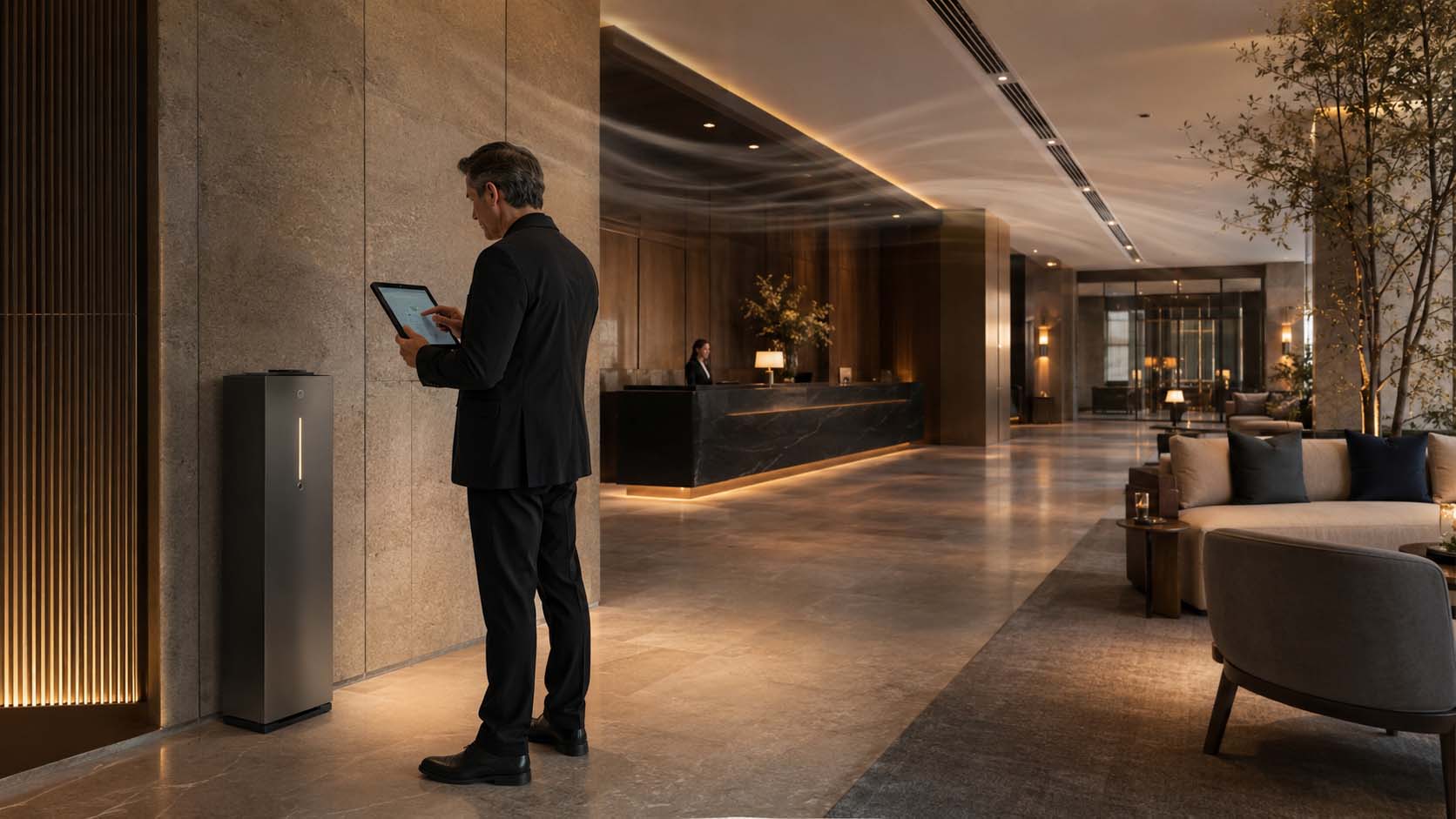
Imagine un vestíbulo de techo alto con puertas giratorias, un salón a un lado y mostradores de recepción al otro. El objetivo es una fragancia distintiva y sutil al llegar, no una fragancia intensa junto al mostrador de recepción.
Un ingeniero calcula el volumen cúbico y revisa el flujo de aire. Una zona HVAC compatible puede proporcionar una distribución amplia; un salón que requiera una intensidad diferente puede necesitar una segunda zona o una unidad independiente silenciosa.
El hotel debe probar con una intensidad baja, recopilar comentarios y comprobar los espacios adyacentes. El éxito significa consistencia y aceptación, no simplemente que la fragancia sea perceptible.
Un minorista con 20 tiendas puede tener distribuciones HVAC inconsistentes y diferentes superficies. Instalar la misma máquina grande conectada a los conductos en todas partes aumentaría los costos sin garantizar un resultado uniforme.
Un mejor plan agrupa las tiendas por volumen y flujo de aire y luego prueba dos o tres modelos independientes. Después, la dirección compara el tiempo de permanencia, la conversión, los comentarios, la frecuencia de recarga y la mano de obra con una referencia inicial.
La cotización del equipo representa solo una parte de la inversión comercial. Una comparación útil del costo total incluye:
Costo del difusor y de la instalación
Consumo de aceite aromático según el programa previsto
Mano de obra para recargas y mantenimiento preventivo
Núcleos de atomizadores, sellos, tubos y otras piezas de repuesto
Requisitos de gestión remota o de la aplicación
Tiempo de inactividad y respuesta posventa
Capacitación, envíos, aranceles y requisitos eléctricos locales
Para estimar el ROI, compare el beneficio bruto incremental y las mejoras medibles en la experiencia con el costo total del programa. Evite construir un caso de negocio en torno a una afirmación aislada de la industria. El metaanálisis sobre aromas ambientales muestra por qué el contexto y la ejecución pueden producir resultados positivos, neutros o negativos.
Seleccione el hardware y la fragancia conjuntamente. La formulación del aceite influye en la atomización, mientras que el carácter, la intensidad y la familiaridad cultural del aroma influyen en la respuesta de los clientes.
Antes de pedir aceite de fragancia al por mayor, pruebe muestras en el establecimiento con diferentes niveles de ocupación y distancias. No dé por sentado que un perfil transmite el mismo significado en todos los mercados.
DanQ afirma que su biblioteca incluye más de 3.000 opciones de aromas de categorías de té, florales, frutales, amaderadas y otras. Aun así, los compradores deben solicitar la Ficha de Datos de Seguridad (SDS) vigente, la información aplicable sobre alérgenos, los controles de lote, la confirmación de compatibilidad y los documentos del mercado de destino.
DanQ fabrica equipos de aromatización desde 2009 y presta servicios para proyectos comerciales, domésticos, automotrices y OEM/ODM. Los materiales de la empresa indican que sus productos se han exportado a más de 180 países y regiones y que la fábrica mantiene las certificaciones ISO 9001 y SEDEX.
Para cualquier compra, solicite los certificados vigentes y confirme que los documentos CE, RoHS, SGS u otros correspondan al modelo exacto y al mercado de destino.
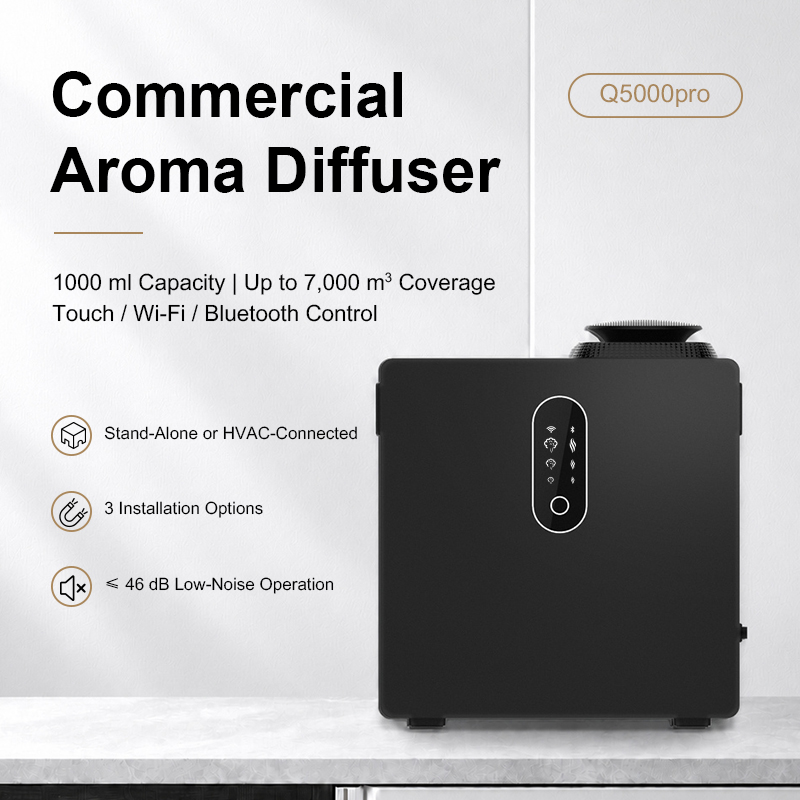
Para espacios grandes, el difusor de aromas HVAC de alta potencia Q5000PRO tiene una capacidad de aceite de 1.000 ml, una cobertura publicada de hasta 7.000 m³, control mediante Bluetooth/pantalla táctil y opciones de instalación independiente, mural o HVAC.
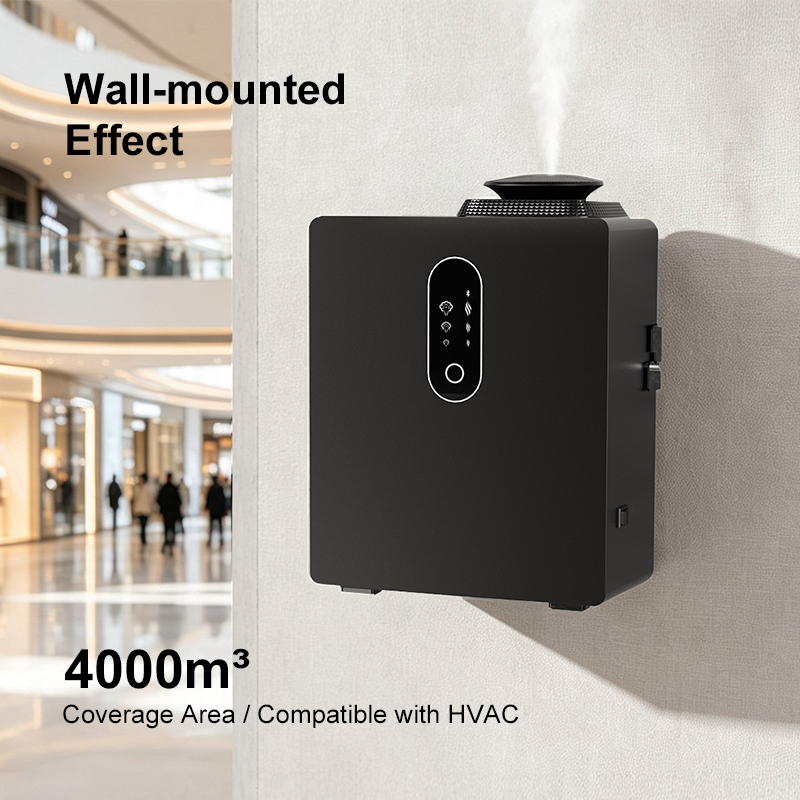
El difusor de aromas HVAC comercial Q3000PRO también utiliza un depósito de 1.000 ml, con una cobertura publicada de hasta 4.000 m³ y opciones de control mediante Wi-Fi, Bluetooth y pantalla táctil.
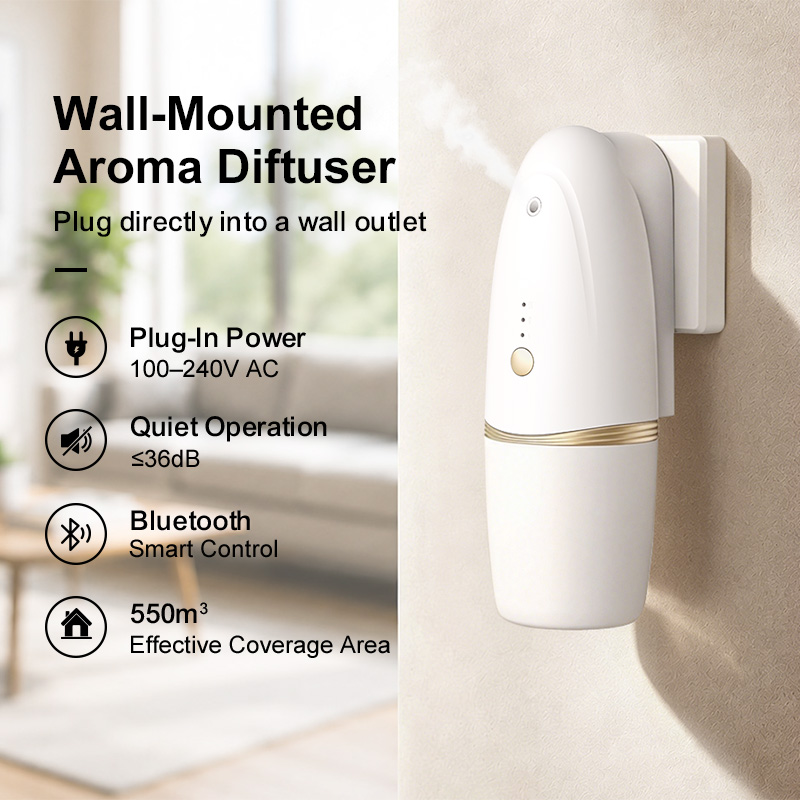
Para áreas de atención al cliente donde el bajo ruido operativo es importante, el difusor de aromas comercial silencioso S915 tiene un nivel publicado de 36 dB.
Estas especificaciones son útiles para elaborar una lista preliminar, no para la ingeniería final. Pida al proveedor de marketing olfativo que recomiende el equipo utilizando el volumen del espacio, el flujo de aire, la zonificación, el horario comercial, la fragancia elegida y la intensidad deseada. La cobertura debe validarse durante la puesta en marcha.
Los distribuidores y compradores de marcas blancas deben pedir a un fabricante de máquinas de aromatización OEM:
Una ficha técnica específica del modelo y los documentos de conformidad vigentes
Pruebas de compatibilidad y consumo del aceite
Datos de ruido con las condiciones de prueba indicadas
Idioma de la aplicación, política de actualizaciones y requisitos de conectividad
Opciones de embalaje, color, logotipo, voltaje y enchufe
Procedimientos de aprobación de muestras y control de cambios
Disponibilidad de piezas de repuesto, alcance de la garantía y proceso de respuesta técnica
Criterios de inspección previa al envío y plazo de producción
DanQ admite la personalización de la apariencia, la marca, el embalaje y determinadas funciones. Convierta cada requisito en una especificación aprobada antes de la producción en masa, incluidos los colores, las ilustraciones, el comportamiento de la aplicación, los accesorios y los límites de calidad.
Comience con una potencia de salida baja y auméntela gradualmente. Realice pruebas durante el horario comercial real y compruebe si la fragancia se desplaza hacia ascensores, habitaciones de huéspedes, tiendas vecinas o áreas del personal.
Durante una prueba piloto de dos a cuatro semanas, registre:
Ciclos de funcionamiento y pausa
Nivel de aceite y frecuencia de recarga
Comentarios de clientes y empleados
Quejas o informes de sensibilidad
Consistencia de la cobertura por zona y hora del día
Métricas comerciales relevantes en comparación con la referencia inicial
El objetivo es crear una atmósfera reconocible pero discreta. Si la mayoría de los visitantes comentan de inmediato lo fuerte que es la fragancia, es posible que el sistema esté proporcionando una intensidad excesiva.
Elija la integración con HVAC para zonas grandes y compatibles que necesiten una distribución centralizada. Elija equipos independientes para una ubicación flexible, aromatización localizada o pruebas piloto rápidas.
En ambos casos, dimensione la solución según el volumen cúbico y el flujo de aire, y luego valídela con el aceite seleccionado en condiciones reales de funcionamiento.
Si está planificando un proyecto de hotel, comercio minorista, oficina, bienes raíces o distribución, envíe a DanQ las dimensiones de su planta, la altura del techo, la información del HVAC, el horario comercial, la dirección de fragancia deseada, el mercado objetivo y la cantidad esperada.
El equipo de DanQ puede recomendar un difusor de aromas comercial adecuado, preparar un catálogo de productos y organizar equipos o muestras de fragancias para su evaluación.
Contacte con DanQ Aroma para obtener una recomendación de proyecto

fabricante profesional, desde 2009.
difundiendo el aroma del amor por todo el mundo.


Guangzhou DANQ Environmental Technology Co.,LTD